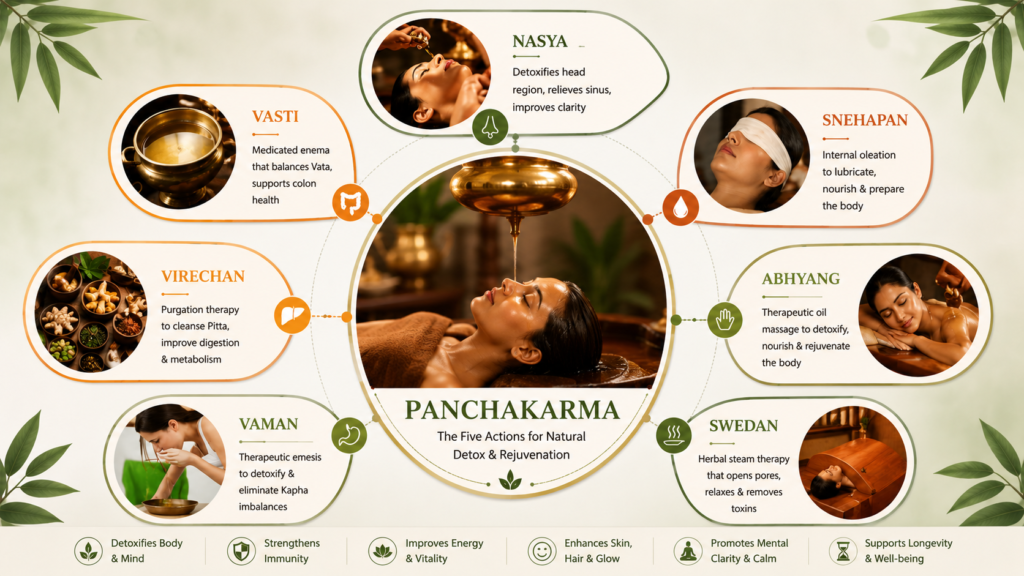
The word Panchakarma is used everywhere in wellness marketing today on spa menus, supplement labels, and resort brochures. In most of these contexts, it means very little. A herbal massage, perhaps, or a 3-day cleanse program with a Sanskrit name attached.In classical Ayurveda, Panchakarma means something specific, precise, and clinically significant. It literally translates as five actions five distinct therapeutic procedures, each targeting a specific dosha imbalance through a specific physiological pathway, each requiring preparation, monitoring, and post-treatment care. These are not interchangeable. They are not optional add-ons to a wellness retreat. They are medical procedures with clear indications, contraindications, and outcomes.
In 25 years of clinical practice, I have administered these therapies to thousands of patients. No two patients have received the same combination. The selection depends entirely on what each individual body needs at that specific point in time determined through a complete Ayurvedic assessment before anything else begins.This article explains exactly what each of the five therapies does, why it works, and when I recommend it. If you are considering Panchakarma and trying to understand what it actually involves, this is the most honest clinical account I can give you.
THE FOUNDATION WHY PANCHAKARMA EXISTS
Before understanding the five therapies, it is important to understand the problem they are designed to solve.
Classical Ayurveda describes disease as arising in six stages from initial doshic imbalance through accumulation, spread, localization, manifestation, and finally chronic entrenchment. Modern medicine typically intervenes at stage five or six, when symptoms are already fully expressed. Ayurveda aims to intervene at stages one through three, before the imbalance has entrenched itself in the tissues.Panchakarma is the clinical tool for this intervention. Its purpose is to eliminate accumulated doshas and Ama (undigested metabolic waste) from the tissues and channels before they cause irreversible tissue damage. This is not a wellness concept. It is a clinical rationale with a clear mechanism of action.
Every Panchakarma program begins with Purvakarma preparatory therapies including internal and external oleation (Snehana) and therapeutic sweating (Svedana). These therapies loosen accumulated doshas from the tissues and mobilize them toward the gastrointestinal tract for elimination. Without this preparation, the main Panchakarma procedures cannot work effectively and may cause harm.
THERAPY 1 VAMANA (THERAPEUTIC EMESIS)
Vamana is controlled, medically supervised vomiting induced using specific herbal preparations to eliminate excess Kapha dosha from the upper gastrointestinal tract and respiratory system.
Kapha accumulates primarily in the stomach, lungs, and upper respiratory passages. When it accumulates excessively through poor diet, sedentary lifestyle, cold and damp environments, or constitutional Kapha predominance it suppresses Agni (digestive fire), blocks the respiratory channels, and creates a characteristic heaviness in both the body and the mind.Vamana is the only direct route of elimination for this upper-body Kapha accumulation. Other therapies cannot reach it effectively.
I recommend Vamana most frequently for patients with chronic respiratory conditions including sinusitis, bronchitis, and allergic rhinitis that do not respond to other treatments. It is also indicated for skin conditions with significant Kapha involvement, certain presentations of obesity and metabolic syndrome, and depression with a characteristic Kapha quality heavy, slow, unmotivated, and resistant to change.The procedure requires 3-7 days of Purvakarma preparation. On the day of the procedure, specific herbal preparations are administered to induce controlled emesis. The patient is carefully monitored throughout. Most patients describe a profound lightness and mental clarity afterward that is difficult to describe until experienced.Vamana is contraindicated in children, the elderly, pregnant women, patients with cardiac conditions, and those who are debilitated. This is not a procedure to be self-administered or approximated with any over-the-counter product.
THERAPY 2 VIRECHANA (THERAPEUTIC PURGATION)
Virechana uses specific herbal laxative formulations to eliminate excess Pitta dosha from the small intestine, liver, and gallbladder. It is the primary Panchakarma intervention for conditions driven by Pitta aggravation and liver dysfunction.
Pitta is the dosha associated with heat, metabolism, and transformation. It governs digestion, hormonal processing, skin integrity, and inflammatory response. When Pitta accumulates excessively through chronic stress, excess spicy or acidic food, alcohol, prolonged heat exposure, or constitutional Pitta predominance it creates a characteristic pattern of systemic inflammation, liver overload, hormonal imbalance, and skin disorders.
The liver is central to Pitta pathology. It metabolizes hormones, processes inflammatory mediators, and regulates bile production. When it is overburdened, the downstream effects are wide-ranging excess androgens drive hormonal conditions like PCOS and hormonal hair fall, compromised bile production disrupts fat metabolism, and systemic inflammation manifests as skin conditions, joint inflammation, and acidity.Virechana directly addresses the liver as a primary target organ. In my clinical experience, it produces some of the most significant and lasting results of any single Panchakarma procedure when correctly indicated.I recommend Virechana most frequently for patients with chronic skin disorders including psoriasis, eczema, and acne that have not resolved with topical treatment. It is also indicated for PCOS and hormonal imbalances with Pitta characteristics, hyperacidity and gastroesophageal reflux, inflammatory joint conditions, and chronic liver dysfunction. In women with PCOS-related hair fall driven by androgen excess, Virechana is often the most effective single intervention.
THERAPY 3 BASTI (MEDICATED ENEMA THERAPY)
Basti is considered the most important of the five Panchakarma therapies in classical Ayurvedic texts. After 25 years of clinical practice, I agree with that assessment without reservation.
Basti administers medicated preparations either herbal decoctions or medicated oils through the rectal route to reach and treat the colon. The colon, in classical Ayurveda, is the primary seat of Vata dosha. Vata governs all movement in the body nerve impulses, peristalsis, joint mobility, hormonal signaling, and the movement of nutrients and waste through every tissue system.When Vata is aggravated through chronic stress, irregular eating, excessive physical or mental activity, trauma, ageing, or constitutional Vata predominance it produces the widest range of conditions of any dosha. Neurological symptoms, joint pain, constipation, reproductive disorders, anxiety, insomnia, fatigue, and hormonal disruption are all potential expressions of Vata aggravation.
Basti works by delivering medicated preparations directly to the colon, where they nourish Vata, correct its movement, and provide the oils and decoctions the dry, depleted Vata tissues need to function correctly.There are two primary types of Basti: Anuvasana Basti, which uses medicated oils and is primarily nourishing and oleating, and Niruha Basti, which uses herbal decoctions and is primarily eliminative. These are administered in specific sequences the Yoga Basti and Kala Basti sequences based on the patient’s condition and the clinical objective.
I recommend Basti for a wider range of conditions than any other Panchakarma therapy. Chronic joint pain and osteoarthritis, neurological conditions including sciatica and lumbar spondylosis, reproductive disorders in both men and women, constipation and irritable bowel syndrome, advanced fatigue and burnout, anxiety and sleep disorders all have significant Vata components that Basti addresses directly.
THERAPY 4 NASYA (NASAL ADMINISTRATION OF MEDICATED OILS)
Nasya administers medicated oils, herbal juices, or powders through the nasal passages. Classical Ayurveda considers the nose the gateway to consciousness the direct route to the brain, the sinuses, and the neurological pathways of the head and neck.
The mechanism is straightforward: the nasal mucosa has a rich blood supply and direct access to the central nervous system through the olfactory nerve and related pathways. Medicated preparations administered here reach the brain and the tissues of the head and neck more directly than oral administration allows.
Nasya begins with a preparatory facial massage using warm medicated oils, followed by gentle steam application to open the nasal passages and dilate the local blood vessels. The medicated preparation is then administered while the patient lies in a specific position that facilitates absorption. The procedure takes 20-40 minutes and is typically administered daily for 7-14 days as part of a larger Panchakarma program.I recommend Nasya most frequently for patients with chronic sinusitis and nasal congestion that has not responded to conventional treatment, migraines and cluster headaches, cervical spondylosis, premature hair fall and greying with a stress or neurological component, insomnia and sleep disorders, mental fog and poor concentration, and anxiety with prominent physical symptoms in the head and neck.
What consistently surprises patients about Nasya is the mental clarity that follows even the first session a lightness and sharpness of mind that many describe as unlike anything they have experienced from any other intervention. In classical Ayurvedic understanding, this reflects the direct effect of the medicated preparation on the pathways linking the nasal passages to consciousness.
THERAPY 5 RAKTAMOKSHANA (THERAPEUTIC BLOODLETTING)
Raktamokshana is the most targeted and most selectively applied of the five Panchakarma therapies. It is used specifically for conditions where impure or vitiated blood (Rakta Dhatu) is identified as the primary driver of a pathological process.
The classical understanding is that Pitta, when severely aggravated, enters and vitiates the blood creating a condition of inflammatory, toxic blood that drives skin disorders, localized inflammatory conditions, and certain types of joint pain. Raktamokshana eliminates this vitiated blood locally or systemically, depending on the method used.At AClinic, I use Jalauka (leech therapy) as the primary method of Raktamokshana. Medicinal leeches have been used in Ayurvedic practice for over two thousand years and have a well-documented mechanism of action their saliva contains hirudin (an anticoagulant), hyaluronidase (which promotes local absorption), and multiple anti-inflammatory compounds. The procedure is classical, safe, and effective for the specific conditions where it is indicated.
I recommend Raktamokshana for chronic and recalcitrant skin conditions including psoriasis, chronic eczema, and deep-seated acne that have not responded to internal treatment, gout and uric acid-driven joint conditions, varicose veins and localized venous congestion, and certain presentations of inflammatory joint pain where the inflammatory load is very high.Raktamokshana is not appropriate for every patient and is never administered without a thorough assessment confirming Rakta Dhatu involvement. It is also contraindicated in anaemia, pregnancy, severe debility, and several other conditions.
HOW I DECIDE WHICH THERAPIES YOU NEED
This is the question I am asked most often: which Panchakarma will I need?
The honest answer is that I cannot tell you until I have assessed you properly. My assessment covers your Prakriti (baseline constitutional type), your Vikriti (current doshic imbalance), your Agni (digestive strength), your Dhatu status (tissue health), your complete health history, current medications, lifestyle, and stress load.
Based on that complete picture, I design a program that may use one, two, three, or all five therapies in a specific sequence, at specific durations, with specific preparatory and post-treatment protocols.
A patient with Kapha-dominant weight gain and respiratory congestion may need Vamana followed by Virechana. A patient with PCOS and hormonal hair fall driven by Pitta excess may need Virechana with a Basti sequence. A patient with chronic cervical spondylosis and anxiety may need Nasya and Basti without any eliminative therapies.
Anyone who tells you which Panchakarma program you need before conducting this assessment is not practicing classical Ayurveda.
FAQ
Q: How long does a full Panchakarma program take?
The complete program including Purvakarma preparation, main procedures, and Paschatkarma post-treatment support typically takes 14-28 days. The exact duration depends on the therapies recommended, the condition being treated, and the patient’s digestive strength and constitution.
Q: Can Panchakarma be done at home?
The preparatory practices of Purvakarma dietary modification, internal oleation can be done at home under guidance. The main Panchakarma procedures require clinical supervision by a qualified Ayurvedic physician. Attempting Vamana, Virechana, or Basti without supervision is dangerous and potentially harmful.
Q: Is Panchakarma safe for someone on allopathic medication?
This is assessed case by case. Panchakarma can often be done alongside allopathic medication with appropriate modifications. A complete medication history review is mandatory before any program begins at AClinic.
Q: Can Panchakarma help with PCOS, thyroid, or hormonal imbalance?
Yes. Virechana and Basti directly address the metabolic and hormonal root causes of PCOS and thyroid dysfunction. In my clinical experience, patients who complete a full program combined with dietary and lifestyle guidance see significant and lasting improvement.
Q: How often should Panchakarma be done?
For healthy individuals as a preventive measure, once a year is the classical recommendation ideally at seasonal junctures. For patients with active conditions, the frequency is determined by the clinical response and the nature of the condition.
Q: Can I consult Dr. Ajayita online before deciding on Panchakarma?
Yes. Online consultations are available for patients across India and internationally. An initial consultation will help determine whether Panchakarma is indicated for your specific condition and which therapies would be appropriate. Book via the website or by calling 0172-2650793.