
You are eating well, exercising, sleeping seven hours. And yet something still feels off. Your digestion is sluggish, your joints ache, your mind is foggy by noon, and no amount of rest fully restores you.This is not a mystery. This is Ama the accumulated toxin load that modern life deposits in your body faster than your system can clear it.Panchakarma is how Ayurveda clears it. Not gently. Completely.
What is Panchakarma
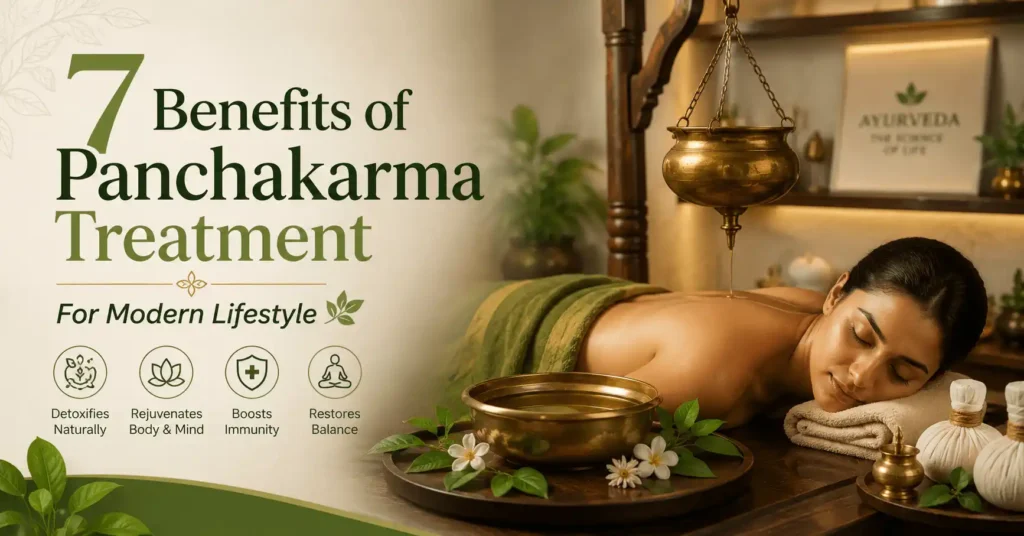
Panchakarma means five actions. It is Ayurveda’s most powerful classical system for purification and rejuvenation not a spa package, not a detox kit, but a structured clinical protocol designed to remove deep-seated toxins from the tissues, restore dosha balance, and reset the body’s own healing capacity.
The five classical procedures Vamana (therapeutic emesis), Virechana (purgation), Basti (medicated enema), Nasya (nasal administration), and Raktamokshana (bloodletting) are selected based on your Prakriti, your current imbalance (Vikriti), the season, and your digestive strength (Agni).At AClinic, Chandigarh, no two patients receive the same protocol. Panchakarma is assessed, designed, and supervised individually. That is classical Ayurveda not a menu you choose from
1. Deep Detoxification at the Tissue Level
Most modern detox programs work at the gut level. Panchakarma goes deeper.Ayurveda describes seven tissue layers (Dhatus) Rasa, Rakta, Mamsa, Meda, Asthi, Majja, Shukra. Ama, when left untreated, lodges not just in the gut but in the joints, the vessels, the nervous system, the reproductive tissue. This is why chronic fatigue, persistent joint pain, brain fog, and hormonal disruption often resist symptomatic treatment the root is deeper than the symptom.
Panchakarma’s preparatory phase (Purvakarma) which includes Snehana (internal and external oleation) and Swedana (herbal steam) specifically mobilises Ama from the deep tissues back to the gut for elimination. The main procedures then complete the removal.This is detoxification at the Dhatu level. Nothing in modern medicine does this.
2. Breaks the Stress-Disease Cycle
Stress in Ayurveda is not just a mental event. Chronic stress aggravates Vata and Pitta simultaneously disrupting the nervous system, increasing inflammation, destabilising digestion, and accelerating tissue breakdown.Panchakarma therapies directly address this at the nervous system level. Shirodhara the continuous pour of warm medicated oil on the forehead regulates the hypothalamic-pituitary axis. Abhyanga with warm taila pacifies Vata through the skin. Basti, the most important of the five procedures, calms Apana Vata, which governs the entire downward-moving energy of the body including elimination, menstruation, and nervous system grounding.Patients who complete a Panchakarma programme do not just feel relaxed. Their cortisol patterns change. Their sleep deepens. Their reactivity reduces. This is not placebo it is systematic neuroendocrine recalibration through classical Ayurvedic therapy.
3. Restores Digestive Fire (Agni)
In Ayurveda, all disease begins with impaired Agni. Every chronic condition I see in clinic from arthritis to thyroid imbalance to PCOS to recurrent infections has compromised Agni at its root.Panchakarma resets Agni by removing the Ama that is suppressing it, and then rebuilding digestive capacity through the Paschatkarma (post-procedure) phase with specific Samsarjana Krama diet protocols.After a proper Panchakarma, patients often report that foods they had avoided for years no longer cause symptoms. That the heaviness after meals disappears. That their appetite becomes clean present when needed, absent when not. This is what a restored Agni feels like. It is one of the most underappreciated outcomes of the programme.
4. Genuinely Improves Sleep Quality
Not the pharmaceutical kind of sleep where you go unconscious but wake unrefreshed. The kind where you fall asleep without effort, stay asleep, and wake with energy.Disturbed sleep in Ayurveda is almost always a Vata imbalance specifically aggravated Prana Vata in the head and Apana Vata in the lower body. Panchakarma addresses both. Shirodhara in the preparatory phase, Nasya to clear the channels above the clavicle, and Basti to ground Apana Vata this combination produces the deepest sleep improvement of any intervention I have seen in 25 years of practice.Most patients report significant improvement in sleep quality by day three of a Panchakarma programme. By the end, many patients who had been on sleep medication for years begin to question whether they still need it under medical guidance.
5. Restores Energy and Physical Vitality
The Sanskrit word is Ojas the finest essence of all seven Dhatus, the biological substrate of immunity, vitality, and mental clarity. When Ama accumulates and Agni weakens, Ojas depletes. The result is the chronic tiredness that no amount of sleep, supplements, or coffee resolves.Panchakarma rebuilds Ojas by clearing the channels (Srotas) through which nutrition reaches the tissues. When the pathways are clear, nourishment reaches the Dhatus properly. Tissue quality improves. Strength returns. The heaviness lifts.I describe it to patients this way: Panchakarma does not give you energy. It removes what was blocking your body from generating it.
6. Sharpens Mental Clarity and Emotional Balance
The mind in Ayurveda is not separate from the body. Manas (mind) is governed by the same doshas as the physical system. Rajas (overstimulation) and Tamas (dullness) are mental doshas that accumulate alongside physical Ama.Nasya medicated oils or powders administered through the nasal passage is Ayurveda’s most direct intervention for the mind. The nose is the gateway to the brain (Shira), and properly administered Nasya reaches Prana, the governing energy of the mind. Patients often describe a lightness, clarity, and emotional ease after Nasya that is difficult to explain but immediately felt.Combined with the systemic Vata pacification of the full programme, the mental improvements of Panchakarma are often what patients remember most.
7. Prevents Disease Before It Manifests
This is the dimension of Panchakarma that modern medicine has no equivalent for preventive at the tissue level.Ayurveda describes six stages of disease progression (Kriyakala). The first four stages — Sanchaya (accumulation), Prakopa (aggravation), Prasara (overflow), Sthanasamshraya (deposition in tissues) are largely asymptomatic. You feel vaguely off. Tests show nothing. Modern medicine has nothing to offer because by its definition, you are not yet sick.Panchakarma intervenes at stages one through four. Done seasonally ideally at the junctions of Hemant-Shishira and Grishma-Varsha it prevents Ama from advancing to stages five and six where structural damage and named disease begin.This is why in classical Ayurveda, Panchakarma was not prescribed only for the sick. It was the annual maintenance of the well.
Panchakarma Treatment in Chandigarh AClinic
AClinic is located at SCO 71, Sector 30C, Chandigarh. I have been practising Panchakarma here for over 25 years seeing patients from Chandigarh, Mohali, Panchkula, Zirakpur, Kharar, and increasingly from abroad: Canada, UAE, Germany, and Switzerland.Every Panchakarma at AClinic begins with a detailed Ashtavidha Pariksha the classical eight-fold examination including Nadi (pulse), Mootra, Mala, Jihva, Shabda, Sparsha, Drik, and Akriti assessment. Based on this, the programme is designed for your Prakriti and current Vikriti not a standard package.
Preparatory therapies Abhyanga, Swedana, Shirodhara, dietary preparation precede the main procedures. The duration ranges depending on the depth of imbalance and the goal of treatment.For patients who cannot travel, a modified programme combining online consultation, prescribed home oleation, diet protocol, and internal medicines is available. It is not identical to in-clinic Panchakarma but it addresses the same principles and produces meaningful results.
Panchakarma for Stress and Burnout in Chandigarh
The patients who walk into AClinic most exhausted are often the highest-functioning ones outwardly. Professionals, entrepreneurs, mothers running households and careers simultaneously. Their cortisol has been elevated for so long that they no longer register it as stress it has simply become their baseline.
For this presentation, I typically recommend a programme combining Shirodhara, full-body Abhyanga, Basti (specifically Anuvasana Basti for Vata pacification), and Nasya. The combination works at the nervous system level in a way that no single therapy achieves alone. Most patients experience a qualitative shift in their stress response within the first week.
Panchakarma for Sleep and Joint Health in Chandigarh
These two conditions are more connected than patients expect.
Disrupted sleep aggravates Vata. Aggravated Vata accelerates joint degeneration dryness in the Snayu (ligaments), reduced lubrication in the Sandhi (joints), increased pain sensitivity. Poor sleep and joint pain are often the same underlying imbalance presenting through different pathways.
Panchakarma addresses both simultaneously which is why patients who come primarily for joint pain often leave reporting that their sleep also transformed, and vice versa.
Frequently Asked Questions
What is Panchakarma treatment?
Panchakarma is Ayurveda’s classical five-procedure system for deep purification and rejuvenation. It removes Ama (accumulated toxins) from the tissue level, restores Agni, rebalances doshas, and rebuilds Ojas. It is supervised, personalised, and clinical not a wellness spa experience
How long does Panchakarma treatment take?
The duration varies depending on individual needs and the personalized wellness plan recommended after consultation.
Is Panchakarma suitable for everyone?
Not all procedures suit all constitutions or conditions. Vamana is contraindicated in certain presentations; Virechana in others. This is precisely why classical Panchakarma requires a qualified physician to assess and design the protocol. Self-administered or poorly supervised Panchakarma can cause harm. At AClinic, nothing is done without proper assessment.
Do I need a consultation before Panchakarma?
Yes always. The consultation is where your Prakriti is assessed, your Vikriti understood, and your programme designed. It is the most important part of the process.
Can I do Panchakarma if I am on modern medication?
In most cases, yes with careful planning. I review all current medications before designing the programme to ensure safety and avoid interactions. Panchakarma and modern medicine are not mutually exclusive; they require coordination.
Book a Panchakarma Consultation at AClinic, Chandigarh
If you have been carrying fatigue, joint stiffness, digestive sluggishness, sleep disruption, or a sense that your body is simply not functioning as it should Panchakarma may be the intervention you have been looking for.
Not because it is ancient. Because it works.
AClinic | SCO 71, Sector 30C, Chandigarh +91-172-2650793 Online consultations available for patients across India, Canada, UAE, Germany, and Switzerland.