
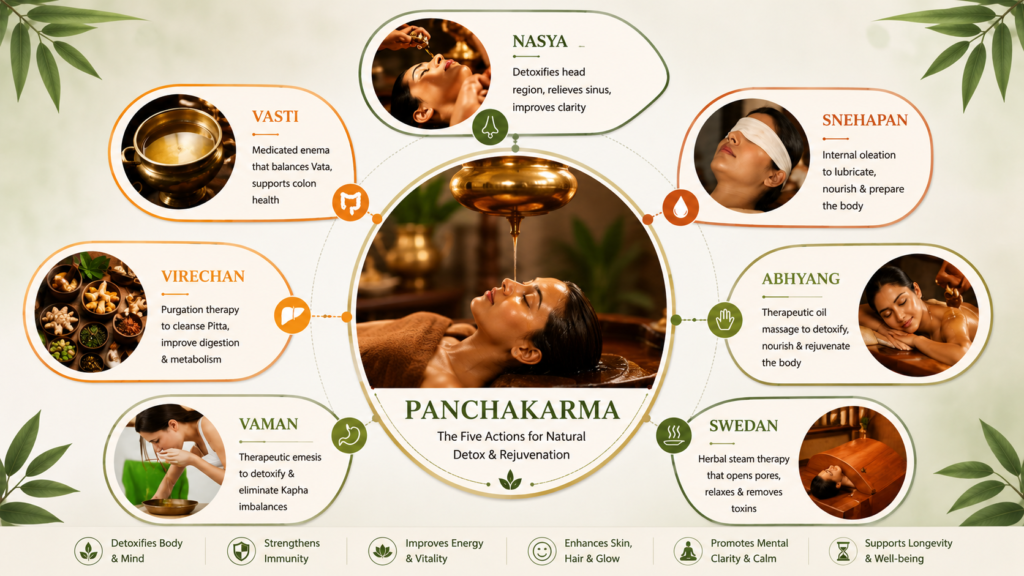
1. Vamana – Therapeutic Emesis
Vamana is a controlled therapeutic emesis procedure traditionally used when aggravated Kapha is considered a major part of the individual’s imbalance. Unlike ordinary vomiting, Vamana is a planned procedure performed after appropriate preparation and under professional supervision
Within the Ayurvedic framework, Kapha is associated with qualities such as heaviness, stability, and accumulation. When Kapha is considered excessive, it may be associated with certain respiratory, digestive, metabolic, and skin-related presentations.
Vamana may therefore be considered in selected cases involving significant Kapha involvement. The decision depends on the individual’s overall condition rather than on a single symptom.
Before Vamana, preparation may be carried out for several days. During the procedure, the person is monitored while the prescribed therapeutic process takes place. Because it is an active procedure, it should not be attempted using home remedies or over-the-counter products.
2. Virechana – Therapeutic Purgation
Virechana is a therapeutic purgation procedure traditionally associated with aggravated Pitta. It involves the controlled use of appropriate herbal preparations to support the elimination process.
In Ayurveda, Pitta is associated with heat, digestion, metabolism, and transformation. When Pitta is considered aggravated, practitioners may assess whether it is contributing to patterns involving What Are the 5 Panchakarma Therapies? Page 2 digestion, skin concerns, inflammatory symptoms, or other health complaints.
Virechana is selected according to the person’s constitution, digestive strength, current condition, and overall suitability. The treatment is not intended to be a generic laxative cleanse and should be planned as part of a broader Ayurvedic programme.
Basti – Medicated Enema Therapy
Basti is one of the most important Panchakarma therapies in classical Ayurveda and is traditionally associated particularly with Vata. It involves administering medicated preparations through the rectal route.
Ayurveda considers the colon an important seat of Vata. Because Vata is traditionally associated with movement and regulation throughout the body, Basti may be considered in treatment plans involving musculoskeletal complaints, constipation, certain neurological presentations, reproductive concerns, and other Vata-related conditions.
There are different forms of Basti. Anuvasana Basti generally uses medicated oils, while Niruha Basti uses herbal decoctions. The type, sequence, and duration are selected according to the individual’s condition and the objective of treatment.
Nasya – Nasal Administration of Medicines
Nasya involves administering a selected Ayurvedic preparation through the nasal passages. In traditional Ayurveda, the nose is considered an important route for therapies involving the head and neck region.
Nasya may be incorporated into treatment plans for concerns such as nasal congestion, sinus-related complaints, headaches, neck discomfort, sleep disturbances, and certain stress-related symptoms, depending on the Ayurvedic assessment.
The procedure may include preparatory facial massage and gentle steam application before the medicine is administered. The exact preparation, timing, frequency, and duration depend on the individual treatment plan.
Raktamokshana – Therapeutic Bloodletting
Raktamokshana is included as the fifth therapy in some traditional Panchakarma classifications. It is considered a specialised procedure used when an Ayurvedic assessment indicates involvement of Rakta Dhatu.
In traditional Ayurvedic understanding, certain Pitta-related patterns may also involve the blood tissue and may present with particular skin or inflammatory concerns. Raktamokshana is therefore considered more selectively than some of the other therapies.
Because this is a specialised procedure, it requires proper assessment and professional supervision. The method and suitability depend on the individual’s condition and treatment objective.
Why Are the 5 Panchakarma Therapies Different?
Each of the 5 Panchakarma therapies has a different therapeutic purpose and route of administration.
Ayurveda does not treat them as interchangeable procedures
Vamana is traditionally associated with Kapha, Virechana with Pitta, and Basti with Vata. Nasya focuses on therapies administered through the nasal route, while Raktamokshana is considered in selected situations involving Rakta Dhatu.
This is why the same Panchakarma programme is not suitable for every person. The therapy should be chosen after understanding the individual’s overall condition rather than simply selecting a popular treatment.
How Can You Get Professional Guidance?
Choosing among the 5 Panchakarma therapies is best done after an individual assessment. At Dr. Ajayita’s Ayurvedic practice, the consultation focuses on understanding your concerns, constitution, current imbalance, digestive strength, lifestyle, health history, and treatment needs before a Panchakarma programme is considered. The recommended therapy may involve one procedure or a carefully planned combination, depending on the individual assessment.
Steps of Panchakarma: How a Program Runs, Step by Step
Panchakarma is not a single treatment on a single day. A full program follows a fixed order. Skipping a step is not safe. It starts with an assessment and then moves through three classical stages. A typical program takes 14 to 28 days.
- Assessment. I begin with Nadi Pariksha and a full health review. This decides whether Panchakarma suits you, which therapies you need, and in what order.
- Purvakarma (preparation). This usually takes 3 to 7 days. Oil therapy (Snehana) and sweating (Svedana) loosen accumulated doshas and Ama. They help move them toward the digestive tract. Your diet is kept simple.
- Pradhana Karma (the main procedures). The therapies chosen for you are given in the order set by your assessment. Only the ones you need are used. You are monitored through each one. The length depends on which therapies are used.
- Paschatkarma (post-treatment care). This usually takes 5 to 14 days. Digestion is rebuilt with a graded diet called Samsarjana Krama, which brings food back in stages. Lifestyle guidance and follow-up medicines are added where needed. Spa packages often leave this step out.
Some sources count five steps: assessment, Snehana, Svedana, the main procedure, and post-treatment care. It is the same sequence, counted differently.
For more on the stages, costs, and who should avoid Panchakarma, read What is Panchakarma Treatment? To book a consultation, see Panchakarma treatment in Chandigarh.
FAQ
What are the 5 Panchakarma therapies?
The five therapies commonly referred to as Panchakarma are Vamana, Virechana, Basti, Nasya, and Raktamokshana. Each has a different therapeutic purpose, and the appropriate procedure is traditionally selected according to the individual’s Ayurvedic assessment.
Can Panchakarma be done at home?
The principal Panchakarma procedures should not be self-administered. Procedures such as Vamana, Virechana, and Basti require proper assessment and supervision, while certain preparatory or supportive practices may sometimes be guided for home use.
How long does Panchakarma treatment take?
The duration varies according to the therapies selected and the person’s treatment plan. Preparation, the main procedures, and post-treatment care can all be part of the programme, so there is no single duration that applies to everyone
Can Panchakarma help with PCOS, thyroid, or hormonal imbalance?
Yes. Virechana and Basti directly address the metabolic and hormonal root causes of PCOS and thyroid dysfunction. In my clinical experience, patients who complete a full program combined with dietary and lifestyle guidance see significant and lasting improvement.
How often should Panchakarma be done?
For healthy individuals as a preventive measure, once a year is the classical recommendation ideally at seasonal junctures. For patients with active conditions, the frequency is determined by the clinical response and the nature of the condition.
Is Panchakarma the same as an Ayurvedic massage?
No. Ayurvedic massage may be used as a supportive or preparatory therapy, but it is not the same as Panchakarma. Panchakarma refers to a specific group of therapeutic procedures carried out as part of a structured treatment approach.
Can I consult Dr. Ajayita online before deciding on Panchakarma?
Yes. Online consultations are available for patients across India and internationally. An initial consultation will help determine whether Panchakarma is indicated for your specific condition and which therapies would be appropriate. Book via the website or by calling 0172-2650793.